
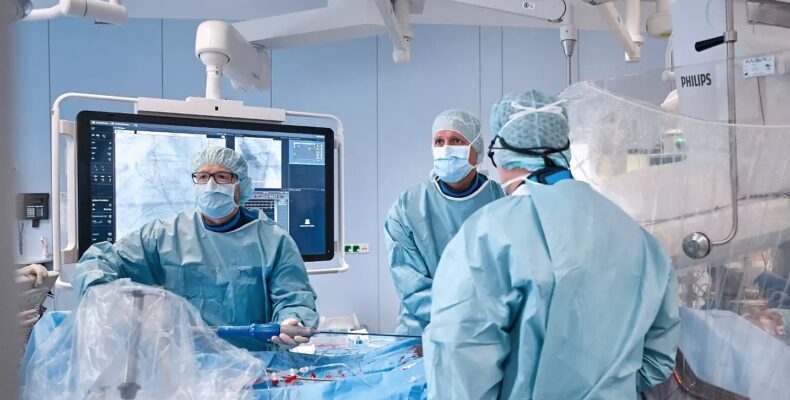
One of the most important shifts in modern cardiovascular medicine has been the transition from purely procedural thinking toward disease management thinking. As technologies have become more advanced and minimally invasive therapies increasingly replace open surgery in selected patients, it has become possible to treat conditions that were once considered inoperable. Yet despite these advances, one reality remains unchanged: the underlying disease process often continues long after the procedure itself has ended.
This distinction is particularly important in vascular and endovascular therapies, where technical success during the operation does not always translate into durable long-term outcomes. A procedure may be executed perfectly, imaging may appear excellent, and the patient may recover quickly—yet the biological forces that caused the disease in the first place frequently remain active.
The procedure treats the manifestation of the disease. It does not necessarily eliminate the disease itself.
The Progressive Nature of Cardiovascular Disease
Most advanced vascular pathologies are not isolated events. They are manifestations of a broader and ongoing degenerative process affecting the arterial system over time.
Aortic aneurysms, dissections, peripheral arterial disease, carotid disease, and many structural cardiovascular conditions are influenced by years of:
- Hemodynamic stress
- Pulsatile fatigue forces
- Hypertension
- Atherosclerosis
- Chronic inflammation
- Biological aging of connective tissues
Even when a diseased segment is successfully excluded or reconstructed, the surrounding vasculature may continue to evolve.
This is particularly evident in aortic disease. An aneurysm repaired successfully today may later be followed by degeneration of adjacent segments, progressive dilation, branch instability, or distal disease progression years later. Similarly, in peripheral interventions, a technically successful revascularization does not eliminate the patient’s underlying atherosclerotic burden.
Cardiovascular disease is rarely static. Our treatment strategies should not be static either.
The Difference Between Technical Success and Durable Success
Modern medicine has become exceptionally good at achieving procedural success. Devices are more sophisticated, imaging is more precise, and minimally invasive therapies continue to expand the boundaries of what can be treated safely.
However, durability remains the true test of any therapy.
In endovascular aortic repair, for example, immediate technical endpoints—such as aneurysm exclusion, branch preservation, or absence of endoleak—represent only the beginning of the patient’s journey. Long-term success depends on how the repair behaves under years of mechanical stress, biological remodeling, and progressive degeneration of the native aorta.
This is why experienced operators increasingly think beyond the immediate procedure. Questions such as:
- What happens if the disease progresses proximally or distally?
- Will future intervention remain feasible?
- Are adequate landing zones being preserved?
- Is this device strategy durable for the patient’s life expectancy?
often become just as important as the technical execution itself.
A technically successful procedure is not always a durable solution.
Why Device Selection Matters
One of the most underestimated aspects of cardiovascular intervention is the long-term impact of device selection.
In advanced endovascular therapies, the implanted device effectively becomes part of the patient’s vascular system for years—sometimes decades. Radial force characteristics, conformability, fatigue resistance, sealing behavior, branch stability, and long-term material performance all influence how the repair will behave over time.
This is why experienced centers increasingly evaluate technologies not simply based on short-term deliverability or procedural convenience, but on:
- Long-term clinical evidence
- Regulatory rigor
- Real-world performance data
- Distribution history in mature healthcare systems
- Post-market surveillance quality
The long-term behavior of the repair often depends as much on the quality of the device platform as on the procedure itself.
The Role of Surveillance and Lifelong Follow-Up
One of the defining characteristics of modern cardiovascular care is that many patients no longer undergo a single intervention followed by discharge from care. Instead, they enter a long-term surveillance pathway.
This is especially true in aortic disease.
Patients treated with EVAR, FEVAR, BEVAR, TEVAR, or complex hybrid reconstructions require structured imaging follow-up, often for life. The reason is simple: the aorta continues to evolve. Endoleaks, branch instability, progressive degeneration, migration, sac enlargement, and distal disease progression can occur years after the original intervention.
Importantly, this does not necessarily represent procedural failure. In many cases, it reflects the natural progression of the disease itself.
Modern cardiovascular therapy increasingly requires lifelong management strategies, not isolated procedures.
Balancing Innovation with Durability
The rapid pace of technological innovation in cardiovascular medicine has undoubtedly improved patient care. Newer devices, lower profiles, improved imaging integration, and minimally invasive approaches continue to expand therapeutic possibilities.
At the same time, innovation should not overshadow durability.
There is often a temptation within rapidly evolving fields to prioritize novelty over long-term validation. However, experienced clinicians understand that the true value of a therapy becomes clear not at 30 days, but at five or ten years.
This is particularly important when selecting technologies for younger patients or complex anatomies where future reintervention is likely.
The most responsible therapeutic strategies therefore balance:
- Technical feasibility
- Immediate procedural safety
- Long-term durability
- Future treatment options
- Overall disease trajectory
The Shift Toward Disease Management Ecosystems
As cardiovascular medicine evolves, healthcare systems are increasingly recognizing that successful treatment requires more than procedural capability alone.
Long-term success depends on coordinated ecosystems involving:
- Structured surveillance programs
- High-quality imaging follow-up
- Technical and clinical support
- Data collection and outcome monitoring
- Continued medical education
- Careful device selection and governance
This broader infrastructure is becoming just as important as the intervention itself.
The future of cardiovascular medicine lies not only in better procedures, but in better long-term management systems.